


Update 308: Proposed Facility Updates
This November, Oswego Community Unit School District 308 is asking voters to consider a bond referendum to update all 22 school buildings, and the timing works in homeowners' favor. Because existing debt is being paid off, these improvements could happen while actually lowering the debt service tax rate.
Here's why now: 70 percent of our schools were built in the same seven-year span, from 2001 to 2008. That means HVAC systems, roofs, plumbing, and electrical work are all wearing out at the same time.
The $317 million plan takes a comprehensive approach. Most of it — 79 percent — would go toward core infrastructure. The rest would cover safety, security, and other priority needs identified across our buildings.
Every dollar would be protected by law. Bond funds cannot be used for salaries, benefits, or daily operating costs — only for facility and site improvements. If voters approve this referendum, 100 percent of the funds would go where they're promised.
FAST FACTS
FAST FACTS![]()
FAST FACTS
- SD 308 has placed a bond referendum on the November 3, 2026 ballot to address $317 million in proposed districtwide improvements across all 22 school buildings.
- The proposed facility and site improvements can be addressed while still reducing the debt service tax rate.
- A tax reduction is possible because the District’s annual long-term debt payment is declining. Based on current estimates, the portion of taxes tied to the debt service tax rate would decrease by about $100 in 2028 and an additional $56 in 2036 for a home with a fair market value of $335,000. Those savings would accrue each year for homeowners over the term of the new bonds.
- More than 70% of District buildings were constructed between 2001-2008 and require major system replacements.
- 77% of identified facility needs are tied to core infrastructure systems such as HVAC, roofing, plumbing, and electrical.
- The proposed plan includes safety and security upgrades, including improvements to secure entry vestibules, fire protection systems, intercoms, exterior lighting, and access controls.
Ballot Question
Ballot Question![]()
Ballot Question
The following bond referendum question will appear on the November 3, 2026 ballot:
“Shall the Board of Education of Oswego Community Unit School District Number 308, Kendall, Kane and Will Counties, Illinois, alter, repair and equip existing school buildings and improve the sites thereof, including installation of secure entryways, access controls, intrusion detection systems, and enhanced cameras; infrastructure repairs to roofing, mechanical, plumbing, and HVAC systems; science lab improvements; expansions to shared cafeteria/gym spaces; and improvements to provide enhanced energy efficiency; and issue bonds of said School District to the amount of $317,000,000 for the purpose of paying the costs thereof?”
Frequently Asked Questions
Frequently Asked Questions![]()
Frequently Asked Questions
Some questions below have video responses linked. To watch all video responses, view the Update308 YouTube videos here.
Why has SD 308 placed a bond referendum on the November 3, 2026 ballot?
SD 308 has placed a $317 million bond referendum on the November 3, 2026 ballot to address facility needs at each of its 22 school buildings. If approved by voters, bond proceeds would address safety and security, infrastructure, learning environment, and site improvements.
What is a bond measure?
A bond measure allows school districts to borrow money for capital projects, much like a mortgage for homeowners. If voters approve the proposed bond measure, the bonds are repaid over time through property taxes. Referendum bonds cannot be used for operating expenses like salaries or classroom supplies.
If voters approved the proposed bond referendum, why would taxes still go down?
As SD 308 retires existing long-term debt, the District can issue $317 million in new bonds while still lowering the debt service tax rate. For a home valued at $300,000, the portion of taxes tied to the debt service tax rate would drop by about $100 in 2028 and an additional $56 in 2036.
Why now? What is the urgency?
Many building systems are at or near the end of their useful life. Acting now would help avoid higher costs. In fact, each year the District waits to address its facility needs, it is estimated that the cost would increase by more than $12 million. Additionally, with long-term debt being paid off, the facility improvements can be addressed while lowering the debt service tax rate.
How old are the District’s school buildings?
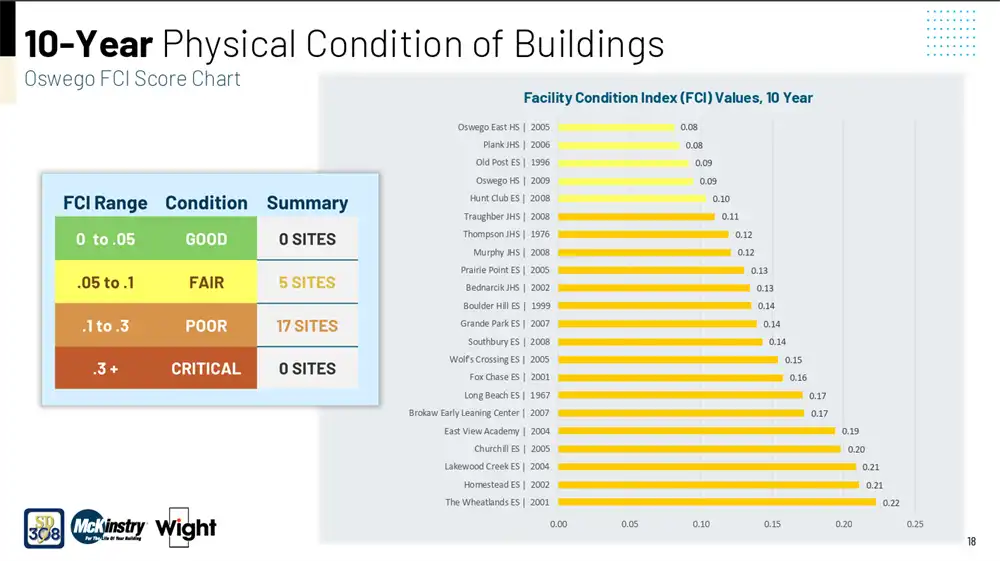
The District’s facilities range from 16 to 67 years old. More than 70% were built within the same seven-year period (2001-2008), and many systems from that era now require replacement.
How did the District identify and prioritize its capital facility needs?
In 2025, the District completed a Long-Range Facility Plan and a comprehensive Facility Condition Assessment. The process included a detailed review of building systems and input from staff and community members. The assessment analyzed:
- Building envelope (roofing, walls, windows)
- Structural integrity
- Mechanical systems (HVAC)
- Plumbing and electrical systems
- Accessibility (ADA compliance)
- Safety and security systems
- Educational and program space needs
- Site conditions (parking lots, sidewalks, playfields)
Why did deferred maintenance occur?
Budget constraints over the years required difficult prioritization decisions. When resources are limited, dollars are directed toward students and classrooms first, meaning facility maintenance is often delayed rather than eliminated. Over time, these deferrals accumulated into the significant infrastructure needs we face today.
Compounding this challenge is a circumstance unique to our district: 22 buildings constructed within a relatively similar timeframe. Unlike districts where facilities are built across many decades, naturally spreading out replacement cycles and costs, our buildings and their mechanical systems are aging together. This convergence means that equipment reaching the end of its life is occurring across multiple buildings simultaneously, resulting in a widespread yet concentrated need that is uncommon for a district of our size.
What will be different going forward?
Our district's strategic plan calls for a proactive, sustainable approach to facility stewardship, and the infrastructure is now in place to make that a reality.
A comprehensive facility audit was completed across all 22 buildings, inventorying every system and piece of equipment, including date of installation and projected end-of-life. This gives us a complete picture of what we have, where it stands, and when it will need attention.
Building on that foundation, a Preventative Maintenance Plan has been developed and is being implemented alongside our new ticketing system. The ticketing system automatically generates alerts at scheduled intervals, prompting the required maintenance on each mechanical asset at the right time, before problems arise.
Together, this approach means:
- Better budget planning — known maintenance intervals and projected equipment lifecycles allow for accurate annual financial planning rather than reactive emergency spending
- Extended equipment life — routine, timely maintenance preserves assets and delays costly replacements
- No more surprise failures — forward planning eliminates the conditions that lead to sudden, widespread breakdowns
- Smarter resource allocation — annual investments in infrastructure are identified and budgeted in advance, replacing the cycle of deferred costs
By investing consistently and strategically in our facilities, we are building a system where maintenance needs are anticipated, funded, and addressed on schedule, protecting both our buildings and the taxpayers who support them.
PROPOSED IMPROVEMENTS
What specific districtwide improvements are planned?
Elementary Schools
Proposed improvements to the elementary schools include:
- Infrastructure upgrades to more efficient systems
- Stronger safety and security
- Sensory and intervention spaces for students with specialized needs
- Separation of gym and cafeteria spaces for two schools using shared space
- Classroom additions for one school
- Updated flooring (less carpet and more washable hard-surface flooring)
Junior High Schools
Proposed improvements to the junior high schools include:
- Infrastructure upgrades to more efficient systems
- Stronger safety and security
- Repurposed computer labs
- Collaboration spaces with visibility and support
- Design improvements to promote inclusivity and student choice
- Updated flooring (less carpet and more washable hard-surface flooring)
High Schools
Proposed improvements to the high schools include:
- Infrastructure upgrades to more efficient systems
- Stronger safety and security
- Updated science labs (OHS)
- Targeted upgrades to CTE and specialized learning spaces
- Improved athletic fields (turf surfaces in stadium and ball fields)
- Renovated bathrooms and enhanced building aesthetics
308 Extension Program
Proposed improvements to the 308 Extension Program facility include:
- Infrastructure upgrades to more efficient systems
- Stronger safety and security
- Additional intervention and resource spaces for individualized support
- Calming areas and sensory spaces for students
- Design improvements to maintain a warm, welcoming, and inclusive environment
POTENTIAL BENEFITS
What are the anticipated benefits of the proposed improvements?
There are many anticipated benefits, including:
- Creating safer, healthier, and more secure schools
- Extending the useful life of existing facilities
- Reducing costly and disruptive emergency repairs
- Addressing areas of overcrowding
- Strengthening college and career readiness
- Improving energy efficiency, saving taxpayer dollars
- Attracting and retaining quality teachers and staff
- Decreasing the debt service tax rate
- Protecting property values
How could the proposed facility improvements benefit residents who do not have school-age children in the District?
Public schools don’t just belong to those who use them, but to all residents within the district. High-quality local schools can attract new residents and businesses to the area, help protect property values, and provide opportunities for shared space for programs, activities, and meetings. Schools can also be a source of community pride and play a vital role in an area’s local economy.
FINANCING THE PLAN & TAX REDUCTION DETAILS
What is the estimated breakdown of the use of the $317 million of bond funds?
The proposed breakdown of bond proceeds is as follows:
- $250 million: Infrastructure Improvements (roofing, HVAC, plumbing)
- $30 million: Safety and Security (including cameras and visitor sequence)
- $37 million: Learning Environments and Other Facility/Site Improvements (student learning space renovations, playgrounds, fields)
When was the last time voters approved a bond measure for SD 308?
Voters last approved a bond referendum nearly 20 years ago, in 2006, to fund school construction projects.
If voters approve the proposed bond referendum, why would the debt service tax rate go down?
With the District paying off long-term debt associated with the 2006 referendum, the current debt service tax rate can be reduced. In fact, the District can issue $317 million in new bonds and still lower the debt service tax rate. For a home valued at $300,000, the portion of taxes tied to the debt service tax rate would drop by about $100 in 2028 and an additional $56 in 2036.
How can homeowners estimate how much their taxes would go down?
View the tax calculator on this page for estimates.
Would waiting to address the District’s capital facility needs increase costs?
Delaying improvements could increase costs due to construction inflation and lead to more frequent emergency repairs, which are more costly and disruptive. Assuming construction inflation of 4%, the total cost of the proposed improvements is estimated to increase by more than $12 million annually if not addressed.
Has the District been fiscally responsible?
The District continues to make responsible financial decisions to reduce expenses and protect taxpayers. Here are just a few examples of recent efforts:
- Refinanced bonds, saving taxpayers $11.3 million in interest.
- Reduced short-term borrowing, lowering interest expenses and
strengthening credit. - Joined a lower-cost health insurance cooperative, saving $1 million.
- Secured a more affordable property and liability insurance carrier, saving the equivalent of 11.58 staff positions.
- Reduced expenses through competitive bidding, short-term investment earnings, and expanded use of grant funding.
Why can’t existing funds be used to address the proposed improvements?
Major districtwide infrastructure replacements often require funding far beyond what a school district’s annual operating budget or reserves can support. This is especially true for SD 308, where growing financial challenges have significantly reduced available resources. Here are just some of the District’s funding challenges:
- The State reduced the District’s revenue by $8 million this year with no warning, creating an immediate budget shortfall.
- Illinois reimburses only 61 cents per dollar for Special Education expenses, leaving the District with a nearly $32 million deficit.
- The District must cover about 40% of the required busing costs using its own local funds, even though transportation is a State requirement.
- Illinois laws limit the District's ability to receive additional revenue when home values rise.
- More than 70% of schools were built between 2001-2008, so major systems now need replacement at the same time, further straining the budget.
COMMUNITY INVOLVEMENT AND OVERSIGHT
How can residents continue to learn more and provide input?
Residents can stay informed and share feedback in several ways. Residents may attend Board meetings or upcoming public information sessions, review planning documents and informational mailers distributed by the District, and participate in a districtwide public opinion survey. In addition, the District’s website will provide ongoing updates, resources, and opportunities for community input.
Who will get to vote on the bond referendum?
All registered voters residing within SD 308 boundaries would be eligible to vote.
Would there be public oversight if the plan is approved?
Yes. If the referendum is approved, the District would provide regular updates on spending and construction details through its website, social media, and other existing communications channels.
What if residents need more information?
Residents may submit questions or concerns to Update308@sd308.org
BACKGROUND INFORMATION
How many schools are in SD 308?
SD 308 includes 22 schools: 13 elementary schools, 5 junior high schools, 2 high schools, an early learning center, and a therapeutic day school. Additionally, the district operates a transition program for students aged 18-22 with special needs and an alternative learning program.
Which communities are served?
The District serves all of Oswego and portions of Aurora, Joliet, Montgomery, Plainfield, and Yorkville.
How many students attend SD 308 schools?
Approximately 16,700 students attend the District’s schools.
How large is SD 308 compared to other Illinois districts?
SD 308 is the 7th largest school district in Illinois, covering 68.8 square miles.
What role does SD 308 play in the local economy?
SD 308 is the largest employer in Kendall County, with more than 2,477 employees, supporting the local economy and community workforce. Most of SD 308’s staff are also residents in the district.
Debt & Capital Finance Overview
Debt & Capital Finance Overview![]()
Debt & Capital Finance Overview
Infrastructure Projects Completed 2024–26
Infrastructure Projects Completed 2024–26 ![]()
Infrastructure Projects Completed 2024–26
Each year, the District replaces outdated or failing equipment as the budget allows and as grant funding becomes available. The need far exceeds the resources available in any one year, so projects are prioritized by urgency, starting with systems that have failed or are closest to failing. The list below shows projects completed over the past two years.
The Facility Condition Assessment now helps guide these decisions by tracking the age and expected end-of-life of every major system in all 22 buildings.
Facility Tours
Each school building in SD 308 has a list of specific needs that would be addressed by this bond referendum. To hear about these needs is one thing, but to see everything that requires improvement is another.
SD 308 invites community members to book a tour of any buildings to better understand the current state of facilities and see what updates are proposed.
Please email update308@sd308.org to schedule a time for a school facility tour.
Have a Question? We're Listening.
SD 308 is committed to providing clear, timely answers to questions from our community. Whether you're curious about facility needs, funding, or what the proposed updates would mean for your family, we want to hear from you. Ask a question, share a concern, or request more information.
Upcoming Information Sessions
Upcoming Information Sessions![]()
Upcoming Information Sessions
- October 19 at 6:30 pm - Inside 308: Walls That Talk at The Wheatlands Elementary School (2290 Barrington Dr W, Aurora, IL)
- October 21 at 6 pm - Bilingual Parent Advisory Committee (BPAC) Meeting at Plank Junior High School (510 Secretariat Ln, Oswego, IL)
- October 27 at 5 pm - Update308 Community Meeting: Safety & Security at Oswego East High School (1525 Harvey Rd, Oswego, IL)
- October 29 at 5 pm - Your Schools, Your Questions at the Montgomery Police Department (10 Civic Center Ave, Montgomery, IL)
 More than 70% of District buildings were constructed
between 2001-2008 and require major system replacements.
 77% of identified facility needs are tied to core infrastructure
systems such as HVAC, roofing, plumbing, and electrical.
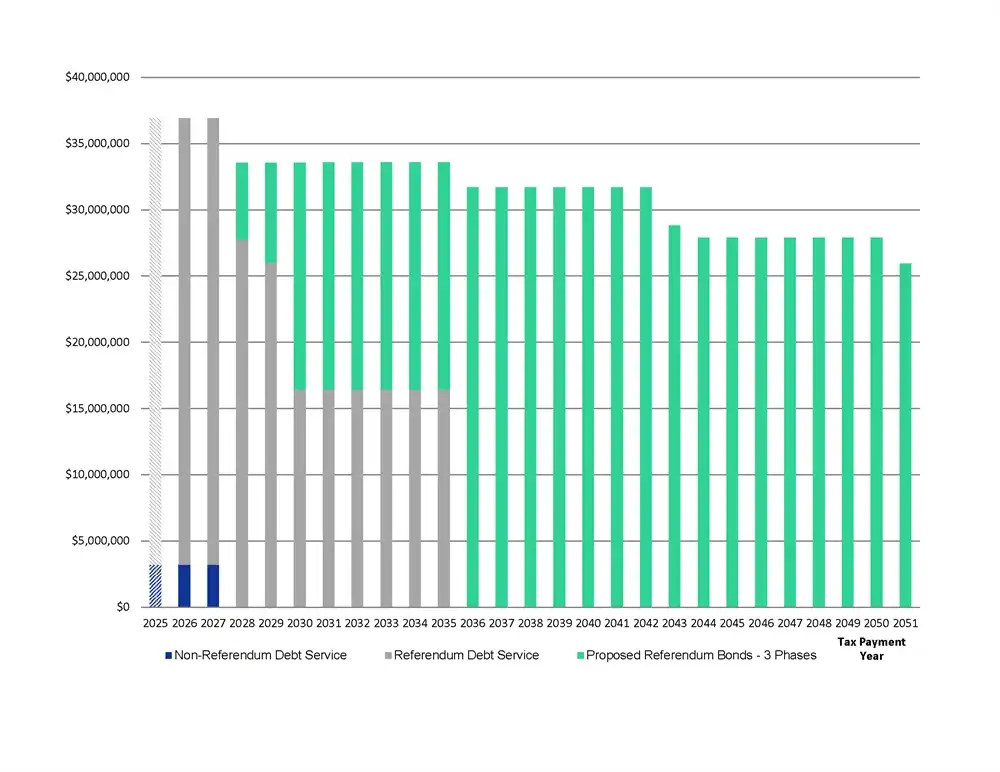
With the District paying off long-term debt associated with the 2006 referendum, the current debt service tax rate can be reduced. In fact, the District can issue $317 million in new bonds and still lower the debt service tax rate. For a home valued at $300,000, the portion of taxes tied to the debt service tax rate would drop by about $100 in 2028 and an additional $56 in 2036.

Tax Calculator
Tax Calculator![]()
Tax Calculator
Transparency matters. This calculator is designed to help you understand how the proposed updates could affect your property taxes.
Recent Infrastructure News
Recent Infrastructure News![]()
Recent Infrastructure News


